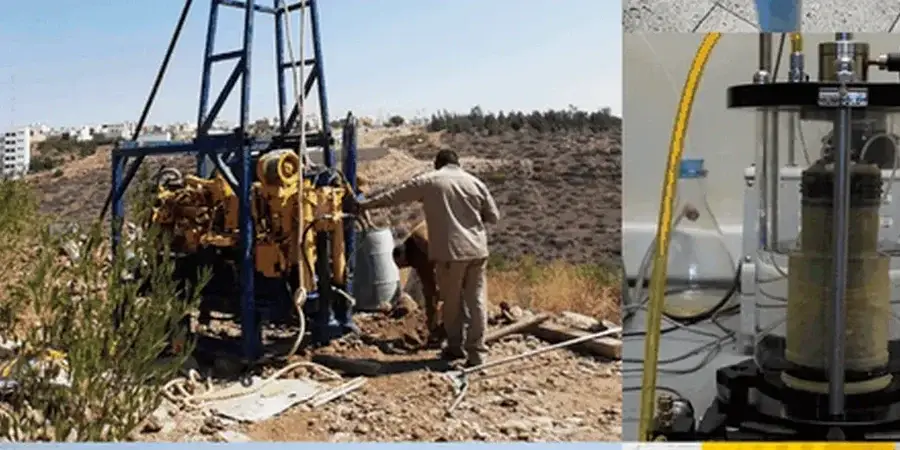
The direct shear box comes out of its loading frame first thing on Monday mornings here. It has to. Half the samples coming through our Nelson lab are silty gravels from the Richmond foothills or loose sands from the Tahunanui foreshore, and both need a friction angle before any foundation design can move forward. We sample with a hand auger where access is tight, or with a split spoon when we hit the water table at two metres — which happens often down on the flat land near the Maitai River. The consolidation frame runs overnight. By Tuesday, we have a compressibility curve and a set of shear strength parameters. That is the pace a busy city like Nelson demands, with its mix of residential hillside builds and commercial infill along St. Vincent Street.
A friction angle measured on a properly prepared sample changes the foundation cost by thousands. A guess changes the risk profile forever.
Service characteristics in Nelson
Critical ground factors in Nelson
We were called in after a retaining wall failure on a section above The Wood. The owner had built on uncontrolled fill without a soil mechanics study. Rain saturated the ground behind the wall, and the whole thing rotated forward. It was a classic Nelson problem: steep terrain, variable fill, and drainage that looks fine on a dry day but fails the moment a Tasman front parks itself over the city. We re-logged the exposure, ran direct shear on the fill material, and found an effective friction angle of just 22 degrees. That explained everything. The new design used a retaining walls system keyed into competent Moutere Gravel, with filter fabric and a no-fines backfill to keep pore pressures down. Without the lab data, the engineer would have been guessing at the soil strength. In a region with 52 recognised active faults in the upper South Island, guessing is not an option.
Our services
A soil mechanics study in Nelson pulls together several laboratory and field procedures. These are the two we lean on most when the project brief lands on our desk.
Direct Shear & Triaxial Testing
We run consolidated-drained (CD) shear on the direct shear apparatus for granular soils and unconsolidated-undrained (UU) triaxial tests on cohesive samples. Both give the strength envelope the structural engineer needs for bearing capacity and slope stability calculations.
Consolidation & Compaction Testing
One-dimensional consolidation in the oedometer provides Cc and cv values for settlement prediction. Standard and modified Proctor compaction, with or without soaked CBR, supports earthworks specifications and pavement design across the Nelson-Tasman region.
FAQ
How much does a soil mechanics study cost in Nelson?
A full study typically ranges from NZ$5.030 to NZ$9.870, depending on the number of samples, the test suite required, and whether field sampling is included. A straightforward job on a single residential section sits at the lower end. A commercial development with several boreholes and multiple shear or consolidation tests moves toward the upper end.
What soil formations around Nelson need the most careful testing?
The Moutere Gravel and its clay matrix can be deceptive — it looks solid in a test pit but loses strength when saturated. We pay close attention to the fines content and plasticity. The Tahunanui sands also warrant careful evaluation, particularly for liquefaction potential given Nelson's seismic setting.
How long does laboratory testing take once the samples arrive?
Basic classification and compaction results are usually ready in three to five working days. Consolidation and shear tests take longer — the oedometer and triaxial cells need time for saturation, consolidation, and shearing stages. A complete study typically runs ten to fifteen working days, depending on the queue and the complexity of the program.