The soil behaviour between Tahunanui’s flat sands and the clayey foothills of Atawhai can differ dramatically. One drains freely, the other holds moisture and swells with the seasons. Understanding that difference is what the Atterberg limits test is for. We run liquid limit and plastic limit determinations on cohesive materials across the Nelson region, giving engineers the plasticity index they need to classify fine-grained soils correctly. The test is straightforward, but the preparation matters. Our lab follows strict moisture conditioning and sieving procedures so the results hold up under NZS 3404 and the NZGS guidelines. When a site investigation hits silty clays near the Maitai River or weathered argillite in the Port Hills, the Atterberg limits tell you how the soil will behave during cut, fill, and compaction operations.
Plasticity index values above 20% in Nelson’s weathered argillite signal a high shrink-swell risk that must be addressed before slab design.
Service characteristics in Nelson
Critical ground factors in Nelson
The mistake we see too often in the Nelson-Tasman area is assuming all clay is the same. A contractor excavates a site near Stoke, sees brown fine-grained soil, and classifies it visually as low-plasticity silt. Without Atterberg limits, the engineer might specify a standard pavement subgrade treatment. Later, after the first wet winter, the subgrade heaves because the PI was actually 28%, not 8%. That kind of misclassification leads to cracked floor slabs, deformed driveways, and expensive remedial work. The test takes a couple of days and uses a small sample, but skipping it can set a project back months. In areas underlain by the Waimea Group sediments, including the Champion Road industrial zone, we recommend running Atterberg limits on every distinct cohesive layer encountered in the borehole log.
Our services
Beyond the basic Atterberg limits, we run complementary tests that build a complete picture of the fine-grained soil behaviour for your Nelson project.
Linear Shrinkage
Measures the one-dimensional shrinkage of a remoulded soil sample upon drying. Often requested alongside Atterberg limits for road subgrade assessments.
Moisture Content
Oven-drying method per NZS 4402. We report natural moisture content as a ratio to the plastic limit to quickly assess in-situ consistency.
Soil Classification Package
Bundles Atterberg limits, grain size distribution, and organic content testing into one report with full NZGS classification.
FAQ
What exactly do the Atterberg limits measure?
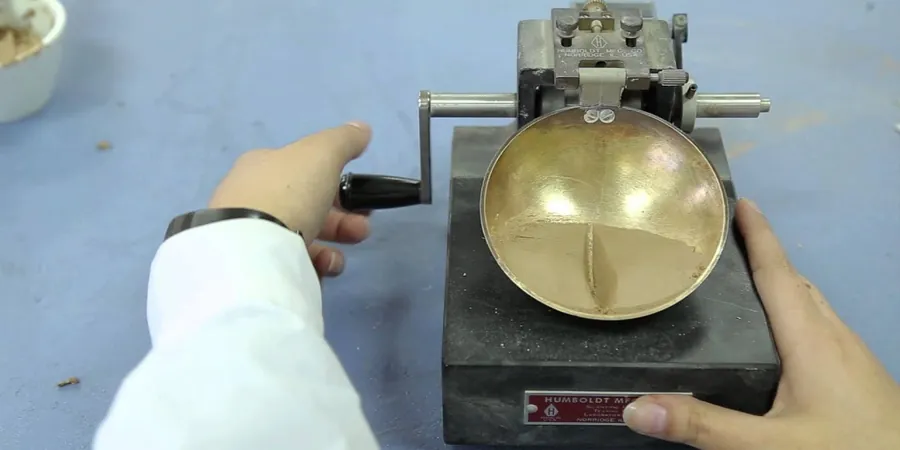
They define the water contents at which a fine-grained soil changes state. The liquid limit is the moisture content where the soil flows under 25 blows in the Casagrande cup. The plastic limit is where the soil crumbles when rolled into a 3 mm thread. The plasticity index is the numerical difference between the two and indicates the range of moisture over which the soil remains plastic.
How much soil do you need for an Atterberg limits test?
We require about 200 grams of material passing the 2 mm sieve. It is best to send a larger bag of disturbed sample so we can extract the representative fine fraction in the lab. The sample must be sealed to preserve the natural moisture content.
How much does Atterberg limits testing cost?
For a standard Atterberg limits determination (liquid limit and plastic limit) in Nelson, the fee ranges from NZ$110 to NZ$180 per sample, depending on the number of samples and whether additional drying or sieving is required.
Can you run Atterberg limits on sandy soils?
No, the test is only meaningful for the fine fraction (silt and clay) passing the 425 µm sieve. If the soil is predominantly sand, we would recommend a grain size analysis instead. We always check the material first and advise if the sample is not suitable.
How do I interpret the plasticity index for my Nelson site?
Low PI (0–7%) indicates silt with low compressibility. Medium PI (7–17%) is typical of silty clays. High PI (above 17–20%) points to active clay minerals with significant shrink-swell potential. For Nelson’s weathered argillite, a PI over 20% usually triggers a recommendation for specific foundation measures and moisture control during construction. More info.