A four-storey mixed-use project on Bridge Street got held up for weeks because the preliminary geotech report flagged potential liquefaction in the lower Maitai gravels. The council wanted a site-specific analysis before issuing consent. That scenario plays out across Nelson more often than developers expect. The combination of shallow groundwater and loose Holocene sediments near the Maitai River and along the waterfront creates conditions where cyclic mobility can trigger during a moderate Alpine Fault rupture. Our team runs SPT and CPT campaigns calibrated to NZGS Module 4, then processes the data through simplified procedures to give you a clear pass-fail on the liquefaction trigger for your foundation depth. We also map post-liquefaction settlement so the structural engineer can decide between Improvement or a stiffer foundation system.
A clean-sand layer at 3 metres depth with a qc1Ncs below 80 in Nelson’s high-groundwater zones almost always triggers a mitigation requirement under NZGS Module 4.
Service characteristics in Nelson
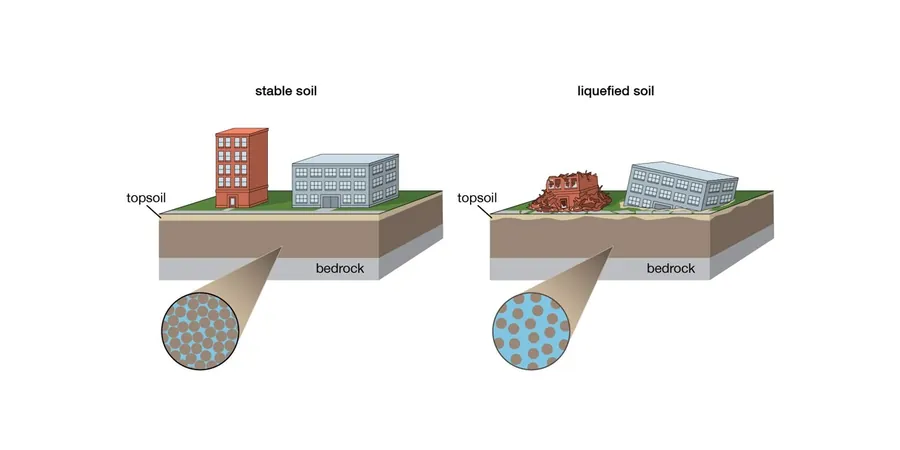
Critical ground factors in Nelson
The difference between a Nelson waterfront site and one up on the Port Hills is night and day for liquefaction risk. Down on Wakefield Quay, you are dealing with reclaimed land over estuarine muds. Saturated, loose, and highly susceptible. Up on the weathered Moutere Gravel terraces near Atawhai, liquefaction is often screened out entirely. The real danger zone sits in the transition: Tahunanui and parts of Stoke where the soil profile looks firm in a hand auger but the CPT picks up a thin, loose sand lens at 4 metres that nobody expected. Miss that layer and the foundation design is compromised. The Building Code clause B1 requires verification that the ultimate limit state is satisfied under seismic conditions; for sites with a liquefaction susceptibility classification of “possible” or “likely”, the only defensible path is a quantitative analysis backed by In-Situ data.
Our services
The liquefaction analysis we deliver in Nelson moves straight to the numbers the structural engineer needs. No generic commentary. Every report ties back to a specific borehole or CPT sounding log, with the triggering curve plotted for each layer.
CPT-based liquefaction triggering
Continuous cone penetration testing with pore pressure measurement, processed to compute the factor of safety against liquefaction at 20 mm intervals. Includes soil behaviour type index, cyclic resistance ratio, and post-liquefaction volumetric strain estimates.
SPT-based liquefaction assessment with laboratory validation
Standard penetration testing at 1.5 m intervals with split-spoon sampling. Laboratory fines content and plasticity index determination on split samples to refine the cyclic resistance correction. Suitable for gravelly profiles where CPT refusal occurs.
FAQ
How much does a soil liquefaction analysis cost for a residential section in Nelson?
For a standard residential section in the Nelson-Tasman area, a site-specific liquefaction analysis typically ranges between NZ$3.890 and NZ$6.660. The final cost depends on the number of test locations required and whether you need CPT only or a combination of CPT and SPT with laboratory fines content testing. We can give you a fixed-price proposal once we review the site location and the council’s consent conditions.
Which NZGS liquefaction category applies to my Nelson site?
The category depends on the ground investigation results and the consequence of failure. Under NZGS Module 4, a site falls into one of three categories based on the liquefaction vulnerability and the importance level of the structure per AS/NZS 1170.0. For a typical IL2 residential dwelling on the Tahunanui flats, the assessment usually requires at least one CPT sounding to 20 metres depth unless the site has already been screened out by a desktop study showing dense Moutere Gravel at shallow depth.
Can you do the testing and have the report ready within three weeks?
Yes, three weeks is achievable for most Nelson sites provided we can mobilise the CPT rig within the first week. The fieldwork takes one day. Laboratory testing on selected samples adds about five working days. The remaining time covers the engineering analysis, drafting of the liquefaction triggering plots, and the senior review sign-off by an engineer experienced with the regional geology of the Tasman District. More info.