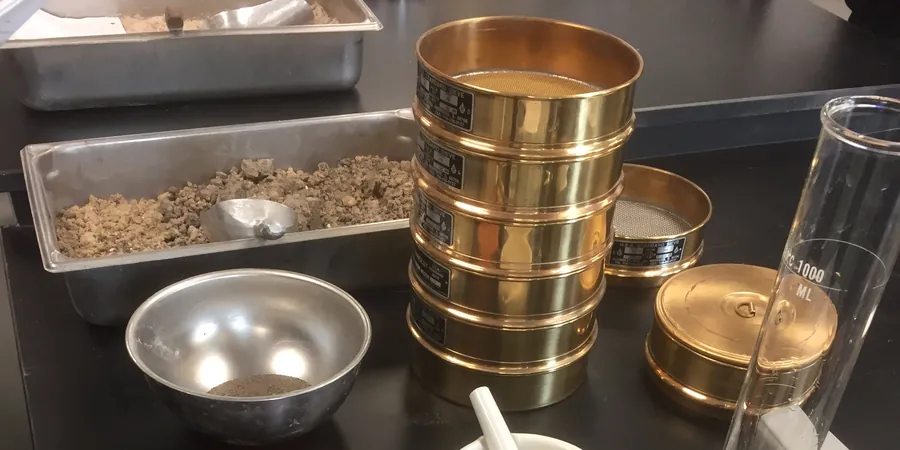
A common mistake we see contractors make around Nelson is assuming that the weathered gravels on site will drain freely, only to find later that a high silt fraction from decomposed schist is trapping water and delaying compaction. The grain size distribution of a soil governs everything from permeability to frost susceptibility, and in a city where alluvial terraces mix with hill-slope colluvium, a single visual classification is not enough to predict performance. Our laboratory combines mechanical sieving for the coarse fraction with a hydrometer analysis for fines, generating a full curve that meets NZS 3404 requirements. For projects near the Maitai River or on the Port Hills, where fill history is often uncertain, we routinely pair this test with an Atterberg limits evaluation so the plasticity of the fines is quantified alongside the gradation. This data becomes the foundation for drainage design, filter compatibility, and earthworks specification, helping you avoid costly rework once the first Nelson winter arrives.
A soil that looks free-draining in the hand can hold enough silt to fail a permeability specification, and only a full hydrometer curve catches that before the pipe bedding goes in.
Service characteristics in Nelson
Critical ground factors in Nelson
Comparing two sites just a few kilometres apart illustrates what is at stake: a foundation pad on the Stoke alluvial gravels may have a D10 above 2 mm and drain almost instantly, while a cut into weathered Moutere Gravel formation on a Tahunanui hillside can produce a matrix-dominated soil with a D10 below 0.01 mm, meaning it holds water and loses strength when saturated. If the grain size analysis is skipped or reduced to a coarse sieve only, the drainage layer specified for the first site gets installed at the second, and the result is a retaining wall backfill that builds up hydrostatic pressure during Tasman Bay rain events. The hydrometer fraction is not an academic exercise here: it directly controls the selection of filter fabrics, the design of subsoil drains, and the assessment of frost action risk, which is relevant in Nelson's inland valleys where winter overnight lows dip below freezing. Getting the full curve right early in the investigation is the cheapest insurance against a drainage failure that surfaces two years after the landscaping is finished.
Our services
Our Nelson laboratory provides several configurations of particle size testing, all run under the same quality system and delivered with a concise interpretation of what the numbers mean for your specific site conditions.
Standard combined analysis (sieve + hydrometer)
Full mechanical sieving from 75 mm to 75 µm followed by sedimentation hydrometer testing on the minus-75 µm fraction. This is the core test for classification to NZGS and for most earthworks and drainage designs.
Wash-sieve only (coarse fraction)
A faster option when the fines content is already known to be low from site investigation and only the gravel-sand split is needed, often used for aggregate compliance checks on locally sourced river run from the Maitai or Wairoa.
Hydrometer-only analysis (fines focus)
Sedimentation analysis on the minus-75 µm portion when the coarse fraction has already been characterised, providing a detailed silt-clay distribution for settlement and permeability modelling.
FAQ
How much does a grain size analysis cost in Nelson?
A standard combined sieve and hydrometer test typically runs between NZ$170 and NZ$310, depending on whether the sample requires extended sedimentation readings or contains a high proportion of gravel that needs riffle splitting. We can give you a firm quote once we know the approximate grading and the number of samples.
How long does the hydrometer part of the test take?
The sedimentation phase requires readings at specified intervals over a minimum of 24 hours, and for soils with a significant clay fraction we often extend this to 72 hours to capture the tail of the fine curve accurately. Combined with the sieving and reporting, the full analysis is typically ready in three to five working days.
Can you test gravelly soils from the Moutere Gravel formation?
Yes, and those are among the most common samples we process. The key with Moutere Gravel is careful splitting to obtain a representative sub-sample, because the coarse clasts can bias the gradation if the field sample is too small. We follow the NZGS recommendations for minimum sample mass based on maximum particle size.
Do I need the hydrometer if I am only designing a driveway sub-base?
For most residential driveways in Nelson where the subgrade is a free-draining gravel terrace, a wash-sieve analysis may be sufficient. However, if you are working on a site with weathered schist or clay-rich colluvium, the hydrometer fraction becomes important because even 10 percent fines can change the drainage behaviour and trigger a requirement for a geotextile separator.