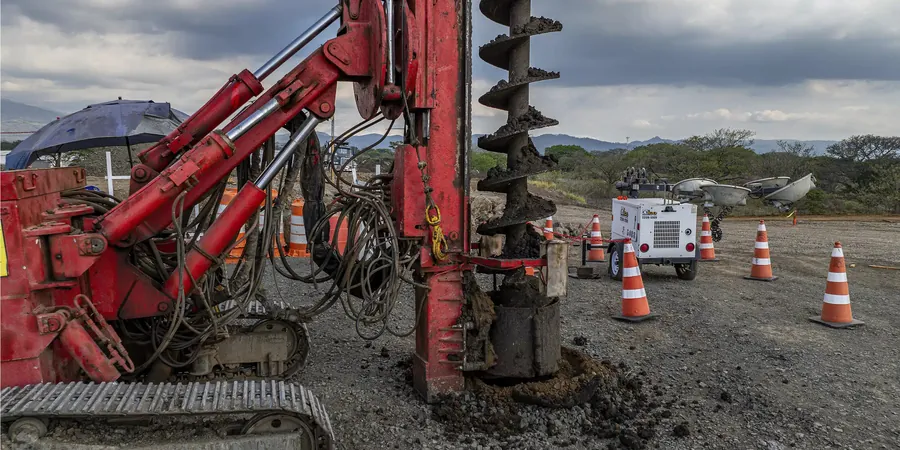
The vibroflot is a long, cylindrical probe that sinks into the ground under its own weight, assisted by compressed air or water jets, and compact the backfill in lifts as it's withdrawn. In Nelson, where the central city and port area sit on reclaimed land over soft estuarine silts, this equipment is often the difference between a feasible build and an expensive excavation. We size the stone columns based on the undrained shear strength of the native material — typically 15 to 40 kPa in the Haven Road corridor — and the settlement tolerance of the structure above. A proper CPT test profile gives us the continuous stratigraphy needed to define column length and diameter, while a liquefaction assessment determines whether densification alone meets the post-earthquake performance requirements under the NZGS guidelines.
A stone column array can reduce post-construction settlement from 120 mm to under 25 mm in Nelson's alluvial silts — that's the difference between a cracked slab and a serviceable floor.
Service characteristics in Nelson
Critical ground factors in Nelson
Nelson recorded a magnitude 6.5 quake in 1968, centred near Inangahua but felt strongly here, and the 2016 Kaikōura event reminded everyone that the Alpine Fault isn't the only source of shaking. Much of the flat land around Nelson Haven and Stoke is underlain by loose, saturated sands and silts that are Class E or F under NZS 1170.5 — meaning they are prone to significant amplification and cyclic softening. Skipping a Improvement study on these soils means accepting a real risk of differential settlement exceeding 100 mm after a moderate event, which would tear apart slabs, buried utilities, and road pavements. Stone columns address this by densifying the soil and providing a drainage path that dissipates excess pore pressure during shaking, directly reducing the liquefaction potential in the improved zone.
Our services
Our Nelson office runs a tight operation focused on two core deliverables for Improvement projects. You get the design calculations and the on-site verification, with no middlemen.
Stone Column Design & Specification
We calculate the optimal grid spacing, column diameter, and depth using site-specific CPT and laboratory data. The deliverable includes a construction specification with aggregate gradation, installation sequence, and QA/QC hold points aligned with NZGS practice.
Post-Installation Verification Testing
We run modulus load tests on individual columns and zone tests on groups to confirm the composite stiffness meets the design assumptions. Results are benchmarked against the settlement criteria in your structural brief, and we issue a signed compliance statement.
FAQ
What does stone column design cost for a Nelson residential site?
For a standard residential lot in Nelson, the design and specification package typically falls between NZ$2.170 and NZ$8.860, depending on whether we need to run additional CPT soundings, lab tests on the aggregate, or coordinate with the structural engineer on load eccentricities. A simple single-dwelling site with existing geotechnical data will sit at the lower end; a multi-unit development with variable ground conditions pushes toward the upper bound.
How do stone columns compare to concrete piles in Nelson's soils?
Stone columns treat the full soil mass rather than bypassing it, which can be more economical when the soft layer is thicker than about 3 metres. They also provide drainage, reducing liquefaction risk — something a pile doesn't do. Piles make sense when you need point support on rock at depth; columns make sense when you want to improve the ground itself and use conventional shallow footings.
What soil conditions in Nelson rule out stone columns?
Columns don't work well in soils with undrained shear strength below about 15 kPa — the lateral confinement isn't enough to form the column properly, and the stone just bulges into the surrounding muck. Very sensitive clays that lose strength when remoulded are also problematic. In those cases we look at alternative methods like rigid inclusions or piled rafts, and we'll tell you upfront if the ground just isn't a candidate.