In Nelson, we often see building platforms cut into hillside without a clear picture of long-term slope behavior. The geology here is not uniform. A site off Atawhai Drive might sit on weathered Moutere Gravel over softer Tertiary sediments, while a section in The Brook can expose fractured Dun Mountain ultramafics. Each demands a different analytical approach. Soil strength drops after heavy Tasman rain, and a slope that stood for twenty years can fail in one wet winter. A slope stability analysis quantifies that risk. We combine field mapping, borehole data from SPT drilling, and lab shear strength to build a model that reflects actual subsurface conditions, not generic textbook assumptions.
A slope that tolerates summer storms can fail in a prolonged winter rain event once pore pressure builds at the slip surface layer.
Service characteristics in Nelson
For large subdivision earthworks in Richmond or Stoke, we layer in CPT testing to define continuous strength profiles through soft alluvium before finalizing the benching geometry.
Critical ground factors in Nelson
The most common mistake we see in Nelson is the assumption that drilling a single hand-auger hole to 2 m is enough. It is not. Failure surfaces in weathered rock often daylight below the depth of a shallow investigation. A developer who skips a proper slope stability analysis risks a Section 124 notice from Council if a cut exposes a weak seam, or worse, a debris flow that reaches a neighboring property. Insurance assessors look for a geotechnical report after landslips: no report means a denied claim. The cost of benching, subsoil drainage, or a tied-back wall is modest compared to remedial works on a moving slope that has already cracked the foundation slab.
Our services
We deliver three tiers of service for Nelson sites, from desktop screening to full engineered design.
Desktop Stability Screening
Review of regional geology, LiDAR slope maps, and historic aerial imagery to flag obvious instability indicators before committing to drilling. Useful for due diligence during property purchase.
Detailed Field Investigation and Modeling
Borehole logging, laboratory strength testing, and 2D limit-equilibrium modeling to calculate FoS under drained and undrained conditions, delivered as a signed Producer Statement.
Stabilization Design and Construction Monitoring
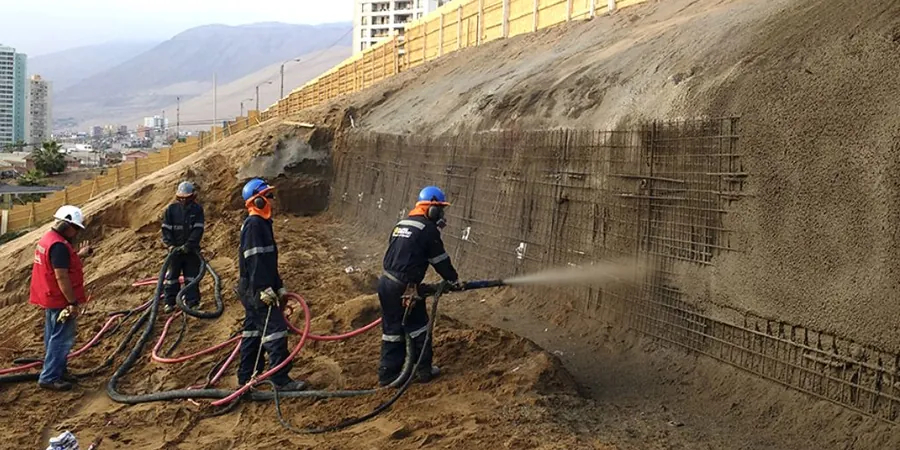
Design of retaining structures, soil nails, or drainage blankets. We supervise benching and anchor installation to verify ground conditions match the design assumptions.
FAQ
How much does a slope stability analysis cost for a single residential section in Nelson?
For a typical single-dwelling site, the cost ranges from NZ$2,370 to NZ$7,640, depending on the number of boreholes, lab testing complexity, and whether a peer review is required by Council. A site with steep terrain and difficult access will be at the upper end.
Does Nelson City Council require a slope stability report for a building consent?
Yes, for any building platform within a mapped landslide hazard area or on a slope steeper than approximately 15 degrees. Council will request a report stamped by a CPEng geotechnical engineer confirming an acceptable Factor of Safety.
What is the difference between a limit equilibrium analysis and a finite element model?
Limit equilibrium methods compute a single factor of safety along a predefined slip surface. A finite element model computes stress and strain throughout the slope and can simulate progressive failure and deformation, which is more representative when weak layers control stability.
How long does a stability assessment take from start to finish?
Field work typically requires one to two days. Laboratory testing adds two weeks, and the analysis and reporting phase takes another five to eight working days. Plan on a total of three to four weeks for a standard residential project.
Can I stabilize a slope with vegetation instead of a retaining wall?
Deep-rooted native planting can help with surface erosion and shallow slumping, but it does not substitute for engineering measures when the failure surface is deeper than about 1.5 m. For deeper instability, subsoil drainage or structural restraint is required.