Nelson’s expansion along the Tasman Bay fringe and up into the Port Hills has placed earthworks front and centre of almost every subdivision consent. The clayey silts derived from Moutere Gravel weathering, combined with loess deposits on the lower slopes, produce fill materials that change behaviour dramatically with just a few percent moisture variation. When Council asks for a minimum relative compaction of 95% on a structural platform, they are really asking for a defensible Proctor reference density. Our team runs both Standard and Modified Proctor tests on these local soils, using NZS 4402 methods, so the contractor on site with a nuclear gauge has a target that actually represents the material coming out of the cut. Because fill in Nelson is rarely clean gravel, we often pair the Proctor with a grain size distribution check to catch oversize corrections before the density target is locked in, and for deeper understanding of the fine fraction we run Atterberg limits to flag reactive clays that can invalidate a standard compaction curve.
A Proctor curve without the ZAV line is incomplete — we plot both so the saturation limit is visible at a glance.
Service characteristics in Nelson
Critical ground factors in Nelson
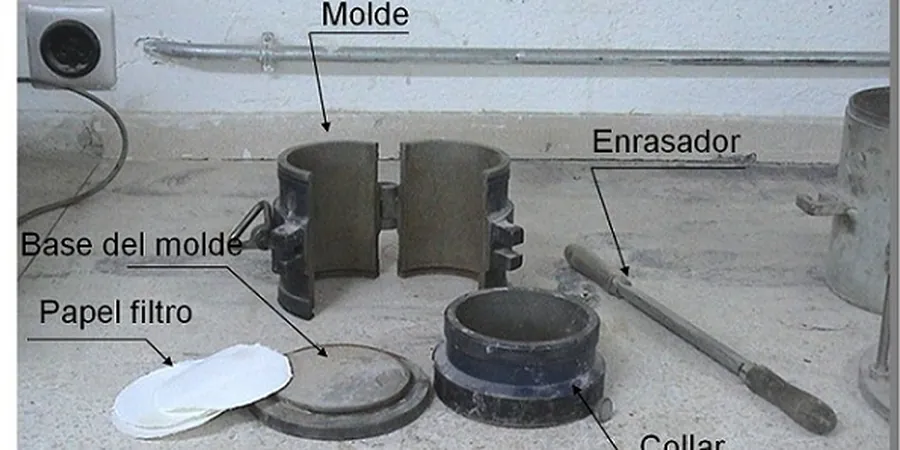
The weathered Moutere Gravel matrix across Nelson can hold a perched water table within two metres of the surface during winter, and the loess veneers on the Port Hills are collapse-prone when placed too dry. A compaction target that looks achievable in the lab can become impossible on site if the borrow material is sitting three percent above optimum after rain. We see this regularly in the Saxton Field and Marsden Valley subdivisions, where clay‑bound gravels need aerating and turning before compaction can meet the 95% or 98% specified. The bigger risk is accepting a Proctor value from a sample that does not represent the bulk of the fill. When a small lens of gravelly soil is sent for testing and the rest of the cut is silty clay, the field density readings will fail repeatedly because the reference curve is wrong. That single mismatch can cost days of rework and trigger a Council non‑compliance notice. Our workflow builds in a material characterisation step — grain size plus Atterbergs — before the Proctor hammer ever hits the mould, so the laboratory curve matches what the scraper is actually placing.
Our services
We run compaction‑related testing for a range of Nelson earthworks scenarios, from small residential pads to arterial road widening. Each package is scoped to the Council consent conditions and the site geology.
Standard and Modified Proctor curves with oversize correction
Full five‑point compaction curves on material sampled from the cut face or stockpile, reported with ZAV line, optimum moisture and maximum dry density. Oversize correction applied per NZS 4402 when gravel content exceeds 10% retained on the 19 mm sieve.
Field density tie‑in and CBR correlation
Nuclear gauge or sand‑cone density testing on site referenced directly to the laboratory Proctor curve. Where the earthworks spec requires a soaked CBR, we compact samples at the target density and moisture before running the penetration test, giving a defensible subgrade strength for pavement design.
FAQ
What does a Proctor test cost in the Nelson region?
A Standard Proctor curve on a single bulk sample typically falls between NZ$160 and NZ$260, while a Modified Proctor curve runs NZ$240 to NZ$360, depending on the number of moisture points and whether oversize correction or companion Atterberg limits are needed. We quote a fixed price after seeing the material and the consent conditions.
Which compaction effort does the Council require — Standard or Modified?
Most residential subdivision consents in Nelson and Tasman District specify a minimum of 95% Standard Proctor density for building platforms and 95% Modified for heavily trafficked pavement subgrades. We check the consent documents and the fill material before recommending the effort, because a Modified curve on a sensitive clay can push the target moisture too low for site conditions.
How quickly can I get a Proctor result if the compaction crew is already on site?
A full Proctor curve with oven‑dried moisture points takes 24 to 36 hours from sample drop‑off to the signed PDF report. If the situation is urgent we can run a rapid three‑point check curve first, but the five‑point curve is still required for the Council sign‑off record.