Nelson sits right where the Richmond Range throws complex alluvial fans against Tasman Bay. The ground shifts character within a single section—gravelly terrace one moment, weathered schist the next. Anchor design here can't be a copy-paste exercise. A strand anchor that holds beautifully in dense Moutere Gravel may creep unacceptably in the clay-bound colluvium of the Port Hills. The distinction between active and passive systems becomes a practical site decision, not just a textbook label. Active anchors lock off immediately against a structure, controlling movement from day one. Passive anchors wait for deformation to engage. In a region that recorded 0.24 g peak ground acceleration during the Kaikōura sequence, that engagement timing matters. Our technical group has pulled bonded lengths across most of the Nelson-Tasman corridor, from Stoke to Atawhai, and the geology never gets boring. For deeper profiling before lock-off, we often run in-situ permeability testing to confirm grout retention in fractured rock.
In Nelson's mixed colluvium and gravel, anchor performance hinges less on the steel grade and more on how the grout column interacts with the surrounding ground.
Service characteristics in Nelson
Critical ground factors in Nelson
The testing rig itself tells the story. A hollow-stem auger spins into the cut, a strand is fed down to the designed bond zone, and high-pressure grout fills the annular space. In Nelson's hillside subdivisions, that rig is often working on a battered bench with barely enough setback for the power pack. The biggest technical headache is confirming grout-to-ground bond in variable rock. A 15-metre anchor in the Moutere Gravel might proof-test beautifully at 1.5 times working load. Shift twenty metres into the weathered schist and the same design can show creep beyond the 2 mm criterion in the first cycle. That's when passive anchors become a safer bet—they rely on progressive load transfer along the full bonded length, forgiving localised weak zones. Corrosion protection is another layer. The marine aerosol from Tasman Bay drifts inland over The Wood and Nelson South, accelerating attack on exposed anchor heads. Double-corrosion-protected (DCP) systems are non-negotiable here, with encapsulation from the internal wedge to the trumpet.
Our services
Anchor design in the Nelson-Tasman region typically branches into two distinct service tracks, shaped by the site geology and the performance required from the retained structure.
Active anchor design and proof testing
Full design of prestressed strand anchors with lock-off procedures, load cell monitoring, and staged proof testing according to NZS 3404. Suited for retaining walls, bridge abutments, and any structure where immediate load transfer and minimal deformation are critical.
Passive rock dowel and soil nail systems
Design of fully grouted passive reinforcement for cut slopes, rock faces, and excavations in weathered schist or colluvium. Includes pull-out testing on sacrificial nails to confirm bond strength before production installation begins.
FAQ
What is the difference between an active and a passive anchor?
An active anchor is stressed and locked off against the structure immediately after grouting reaches sufficient strength, applying a compressive force to the ground before any movement occurs. A passive anchor only develops resistance once the ground deforms and transfers load into the tendon. In Nelson's hillside cuts, we often specify active anchors where neighbouring buildings are within the zone of influence, and passive systems for remote slope stabilisation where some movement is acceptable.
How much does anchor design and testing cost for a typical Nelson project?
For a standard scope covering design, installation supervision, and proof testing of a small anchor array, project costs in the Nelson area generally fall between NZ$2,010 and NZ$7,190, depending on anchor depth, access conditions, and the number of test cycles required under NZS 3404.
Why does corrosion protection matter for anchors in Nelson?
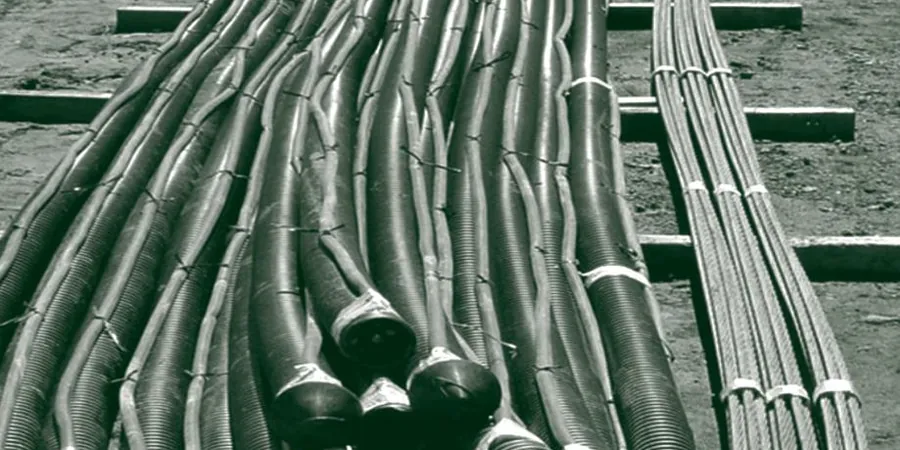
Nelson's coastal environment means airborne chlorides from Tasman Bay can reach anchor heads several hundred metres inland, particularly in suburbs like The Wood and Port Nelson. Chloride attack on unprotected steel can cause stress corrosion cracking over time. Double corrosion protection (DCP) encapsulates the entire tendon—from the internal anchor head wedge to the grout column—with a corrugated plastic sheath and controlled grout cover. NZS 3404 and international practice both require DCP for permanent anchors in aggressive environments.
What proof testing is required for ground anchors?
Every active anchor undergoes a proof test before lock-off. The test involves loading the anchor in steps—typically 25%, 50%, 75%, 100%, and 125–150% of the design working load—and holding at each step while measuring movement with a calibrated dial gauge. The acceptance criterion under NZS 3404 is creep of no more than 2 mm over a 10-minute hold period at 150% of working load. Anchors that fail this test require re-grouting or replacement before the structure can proceed.